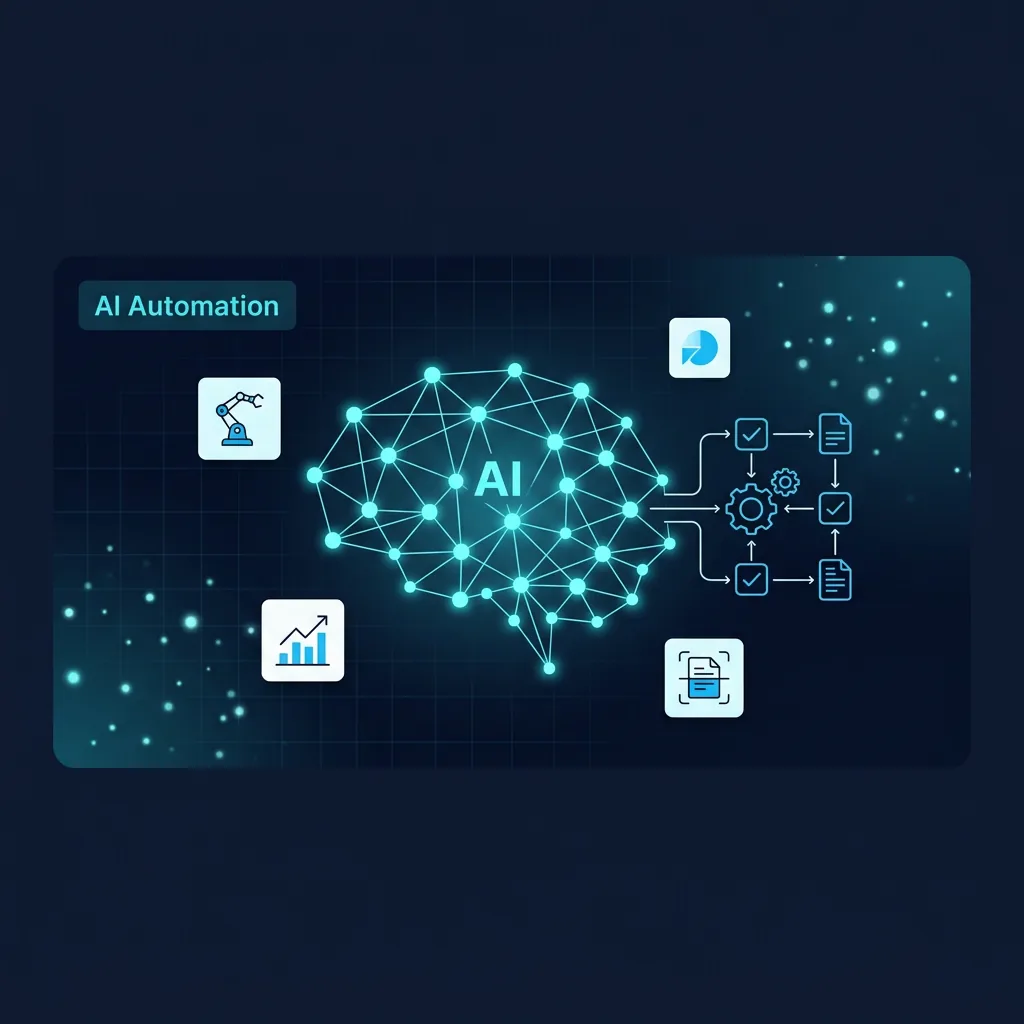
AI automation has moved from a competitive edge to a practical necessity for small businesses. The question is no longer whether to automate but what to automate — and in what order.
This guide covers the five automation categories that deliver the most value for small and mid-market businesses, based on real implementations we have built at Ibistra Tech.
What Small Businesses Can Realistically Automate Today
The most successful AI automations share a common trait: they target repetitive, rule-bound tasks that a human has been doing manually for years. These tasks typically involve reading structured data, applying consistent logic, and producing a predictable output — exactly what large language models do well.
1. Report Generation
Manual reporting is the single biggest time sink across the businesses we work with. Sales reports, production summaries, shift logs, inventory snapshots — each one follows the same pattern: pull data, format it, send it.
With AI automation, you can reduce a two-hour weekly reporting process to a five-minute review. The AI pulls raw data from your system, applies the formatting and narrative logic, and delivers a finished document ready for human review.
In one B2B SaaS deployment, we reduced reporting time by 80% on the first day of go-live. The team's reporting cycle went from three hours of manual spreadsheet work to a 30-minute review-and-send process.
2. Customer Query Handling
A well-configured AI assistant can handle 60–70% of inbound customer queries without any human intervention. The key is scope control: the assistant should handle common, well-defined questions and escalate anything unusual.
For field service businesses, this means answering questions about service windows, engineer ETAs, job status, and basic troubleshooting. For garment manufacturers, it means fielding order status requests, delivery timelines, and fabric availability questions.
The critical implementation detail: the AI must know its own limits. An assistant that confidently answers questions it cannot reliably answer creates more problems than it solves.
3. Document Processing
Invoices, purchase orders, packing slips, and intake forms are high-volume, low-value manual work. AI can extract structured data from these documents with accuracy comparable to trained human operators — and at ten times the throughput.
This is particularly valuable in industries like textile manufacturing, where purchase orders and production records flow in multiple formats from multiple suppliers.
4. Scheduling and Dispatch Optimisation
Field service businesses spend significant time on manual scheduling: matching available engineers to jobs, factoring in geography, skill requirements, and SLA windows. AI scheduling assistants can suggest optimal assignments in seconds, based on rules the business defines.
The value is not just speed — it is consistency. An AI scheduler applies the same logic every time, without the shortcuts or assumptions that humans introduce under time pressure.
5. Internal Knowledge Search
When a team member needs to know the return policy, the commissioning process for a new machine, or the escalation path for a particular client, they typically ask a colleague. That colleague looks it up. This is a tax on experienced staff that scales with headcount.
An internal knowledge assistant eliminates this by indexing your documentation, SOPs, and internal wikis — and returning precise answers rather than documents.
What AI Cannot Replace (Yet)
The boundaries matter as much as the capabilities. AI automation in 2025 is not a replacement for:
- Human judgement on non-routine exceptions. When a job falls outside the defined scope, a human needs to decide. AI handles the 80%; humans handle the 20% that matters most.
- Relationship-based sales and negotiation. Automated outreach has its place, but closing deals in small-business markets still depends on personal trust.
- Creative problem-solving in novel situations. When something has never happened before, the AI has no pattern to follow.
The Total Cost of Doing Nothing
The real comparison for AI automation is not the cost of the automation versus the cost of the manual process. It is the cost of the manual process compounding over time.
A business that is still doing manual reporting in three years will have spent thousands of hours on work that could have been automated. That is staff capacity diverted from growth work. It is also a compounding disadvantage relative to competitors who have already automated.
The businesses that automate now are building process capital. The ones that wait are falling further behind.
Getting Started: Practical Advice
Start with one automation, not five. Pick the task with the highest manual cost and the clearest output — usually reporting or document processing. Build it, measure the time saved, and use that result to justify the next automation.
Avoid the temptation to automate everything at once. Over-automation without validation creates dependencies that are hard to undo when the business logic changes.
For most small businesses, a phased approach works best: start with a single automation that proves the model, then expand systematically once the team understands what good automation looks like.
If you are evaluating where to start, our AI Automation & AI-Native Delivery service page covers the specific workflows we implement — from Claude API-powered reporting to document processing and agentic scheduling tools.
Ibistra Tech builds AI automation for small and mid-market businesses using the Claude API. To discuss your specific workflow, contact us.