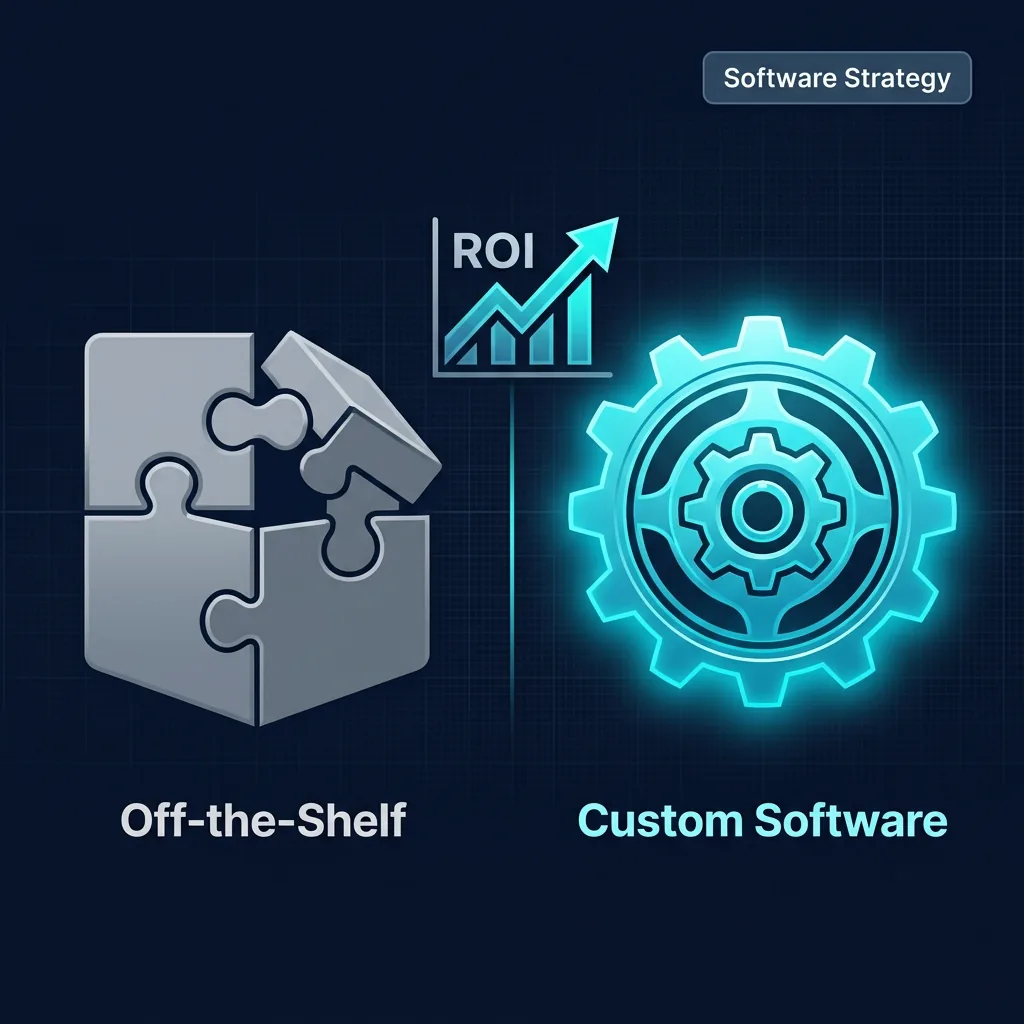
The most common question businesses ask when they outgrow spreadsheets is whether to buy an off-the-shelf product or build something custom. The answer is almost always the same: it depends on how much the software needs to reflect your specific business model.
For generic workflows — accounting, HR, basic CRM — off-the-shelf wins on cost and speed. For workflows that are genuinely specific to how you operate, custom development usually pays back within 18–24 months.
Why Most Businesses Start with Off-the-Shelf
Off-the-shelf software has a compelling pitch: it is ready today, it costs a predictable monthly amount, and someone else maintains it.
For businesses in the early stages of formalising their processes, this is usually the right starting point. The cost of learning what your software needs to do is lower when you are testing assumptions against a real product rather than building a blank canvas.
The genuine advantages of off-the-shelf:
- Deployment in days, not months
- Known cost structure
- Maintained and updated by the vendor
- Generally proven at scale
Where it starts to break down:
- When the software's data model does not match your business model
- When you are doing significant work outside the software (exports, manual calculations, workarounds) to fill gaps
- When a critical workflow requires five steps in the system that your team has learned to do in one
- When vendor pricing increases disproportionately as you scale
What "Custom" Actually Costs
The word "custom" triggers a mental price tag that is often significantly higher than the reality.
A focused custom application solving one specific problem — a production tracking system, a field scheduling tool, a reporting dashboard — can be built and deployed for a fraction of the cost of an enterprise platform. The scope is the cost driver.
The comparison that matters is not "custom vs off-the-shelf software purchase." It is "cost of custom build" versus "cost of off-the-shelf plus the ongoing overhead of working around its limitations."
That overhead is real. It includes:
- Staff time spent on manual workarounds
- Data exported to spreadsheets for processing the software cannot do
- Training new staff on unintuitive processes
- The compounding cost of decisions made with incomplete or slow-moving data
One customer we work with was spending approximately 12 hours per week across three staff members reconciling data between their production management software and their inventory system. The integration work to eliminate that reconciliation loop paid for itself within four months.
The Workflows Where Custom Development Pays Off
Custom software pays off fastest in three categories:
Industry-specific workflows. Generic software is built around the most common version of a business process. If your business operates differently — because of your specific supply chain, production model, or service structure — generic software will always be a poor fit. No amount of configuration fixes a data model that does not match your reality.
Deeply integrated systems. If your operation requires data flowing between multiple systems — warehouse, production, sales, logistics — and you are currently doing that integration manually, a custom integration layer or purpose-built system typically delivers a strong return.
Reporting and decision support. Most off-the-shelf software produces the reports the vendor thought you would need. If the decisions your business makes require data in a different shape, custom reporting is often the fastest path to making better decisions faster.
A Common Pattern We See
Businesses that eventually commission custom software typically follow this trajectory:
- Start with an off-the-shelf product that covers most of the workflow
- Build workarounds for the gaps — exports, manual calculations, separate spreadsheets
- Reach a point where the workaround overhead exceeds the maintenance cost of a custom system
- Commission the custom build, which replaces both the software and the workarounds
The mistake is waiting too long for step four. Most businesses stay in the workaround phase longer than they should because the cost is invisible — it is distributed across individual staff members and never appears as a line item.
When Off-the-Shelf Is the Right Answer
Custom development is not always the right choice. It is not right when:
- Your workflow genuinely matches what the software does
- The business is still evolving and you are not sure what the software needs to do yet
- The team lacks the capacity to manage a build project
- The gap between what the software does and what you need is small enough to bridge with workarounds that cost less than the build
The critical test is whether the software is shaping your workflow or your workflow is shaping the software. If it is the former — if you are changing how you work to match the software's model — that is the clearest signal that custom development will pay off.
How to Evaluate the Decision
Before commissioning a custom build, document the following:
Manual work outside the system. Every time a staff member takes data out of the software to process it elsewhere, note it. How many hours per week? How many people?
Workaround count. Every time someone works around a limitation in the software rather than through the intended process, that is a signal.
Growth friction. Which parts of the current system will break or become unmanageable if the business doubles in the next two years?
If the answers to these questions add up to significant ongoing cost, the case for custom development is straightforward.
For a deeper look at how we approach end-to-end product builds — including our tech stack, delivery process, and common project types — see our Custom Software Development service page.
Ibistra Tech builds custom software for small and mid-market businesses in garment manufacturing, textile production, field service, and SaaS. Talk to us about your specific workflow.