
For CTOs and IT Directors, the AI dilemma is well-understood: you want to empower your teams with generative AI capabilities, but the idea of piping your most sensitive enterprise data into a public SaaS AI application is a non-starter.
Security, compliance, and data governance policies strictly prohibit moving proprietary intellectual property across different cloud boundaries. Yet, building a bespoke LLM orchestration layer from scratch is expensive and time-consuming.
The solution lies in self-hosting your AI orchestration. By deploying an open-source platform like Dify directly within your own data center or private cloud, you retain absolute control over your data while giving your teams a production-ready environment to build chatbots, AI agents, and automated workflows.
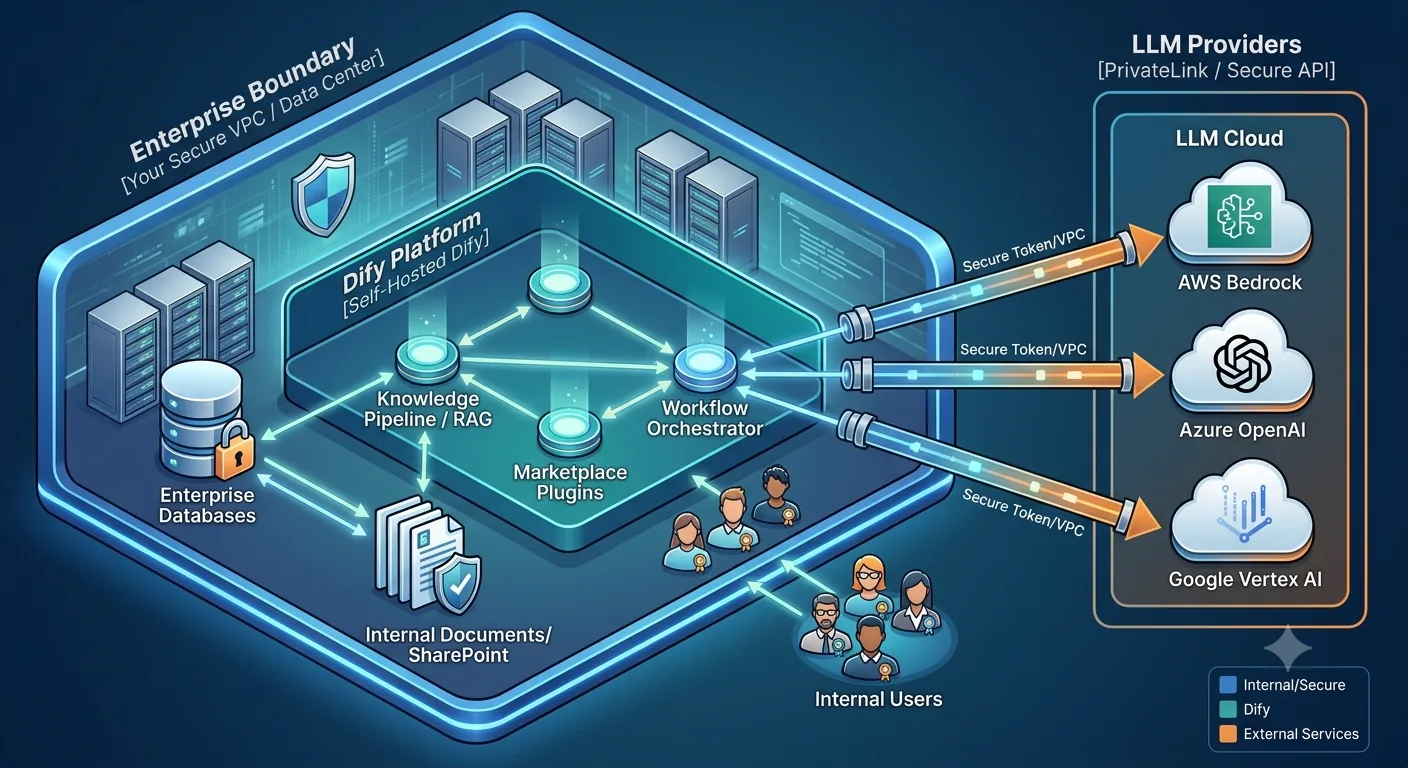
The Architecture of Control
When you rely on a third-party SaaS chatbot, your data leaves your perimeter. By self-hosting Dify, you invert the model: the intelligence comes to your data.
Why Dify is the Ideal Enterprise Engine
Dify acts as an LLMOps and orchestration middleware. It abstracts away the complexity of managing prompts, vectors, and model APIs, providing a visual interface for building applications.
Here is why it stands out for enterprise self-hosting:
1. Bring Your Own Model (BYOM)
You are never locked into a single AI provider. Dify allows you to route prompts to models hosted on your approved enterprise cloud infrastructure. You can securely connect Dify to AWS Bedrock, Azure OpenAI, or Google Vertex AI using your own API keys and private endpoints.
This means your prompts and data are processed under your existing enterprise cloud agreements, ensuring zero data retention by the model providers for training purposes.
2. Out-of-the-Box Knowledge Pipelines
Building a Retrieval-Augmented Generation (RAG) system usually requires stitching together vector databases, embedding models, and chunking logic. Dify provides a production-ready knowledge pipeline out-of-the-box.
You can upload PDFs, sync with Notion, or connect to internal databases. Dify handles the text extraction, chunking, embedding, and hybrid search automatically, ensuring your chatbots ground their answers strictly in your proprietary data.
3. Visual Workflow Automation
Generative AI is most powerful when it takes action. Dify features a drag-and-drop workflow builder that lets your IT team string together complex, multi-step agentic workflows without writing code. You can define logic gates, iterate over data arrays, and chain multiple LLM calls together to automate backend processes.
4. Marketplace Plugins & Integrations
An AI agent needs tools to interact with the outside world. Dify's plugin marketplace makes integration seamless. For example:
- Firecrawl: Natively integrate Firecrawl to allow your agents to crawl, scrape, and extract structured data from competitor websites or external portals.
- Email & Communication: Connect to SMTP, Slack, or Microsoft Teams to allow agents to automatically draft emails, send alerts, or respond to internal support tickets.
The Bottom Line
You do not have to choose between AI innovation and data security. By self-hosting an orchestration platform like Dify in your own environment and connecting it to enterprise-grade model providers like AWS Bedrock or Azure OpenAI, you create a powerful, compliant, and highly scalable AI ecosystem.
Your data stays in your cloud. The AI works for you.
If you are looking to architect and deploy a secure, self-hosted AI environment for your enterprise, Ibistra Tech can help. Get in touch with our engineering team to discuss your workflow.