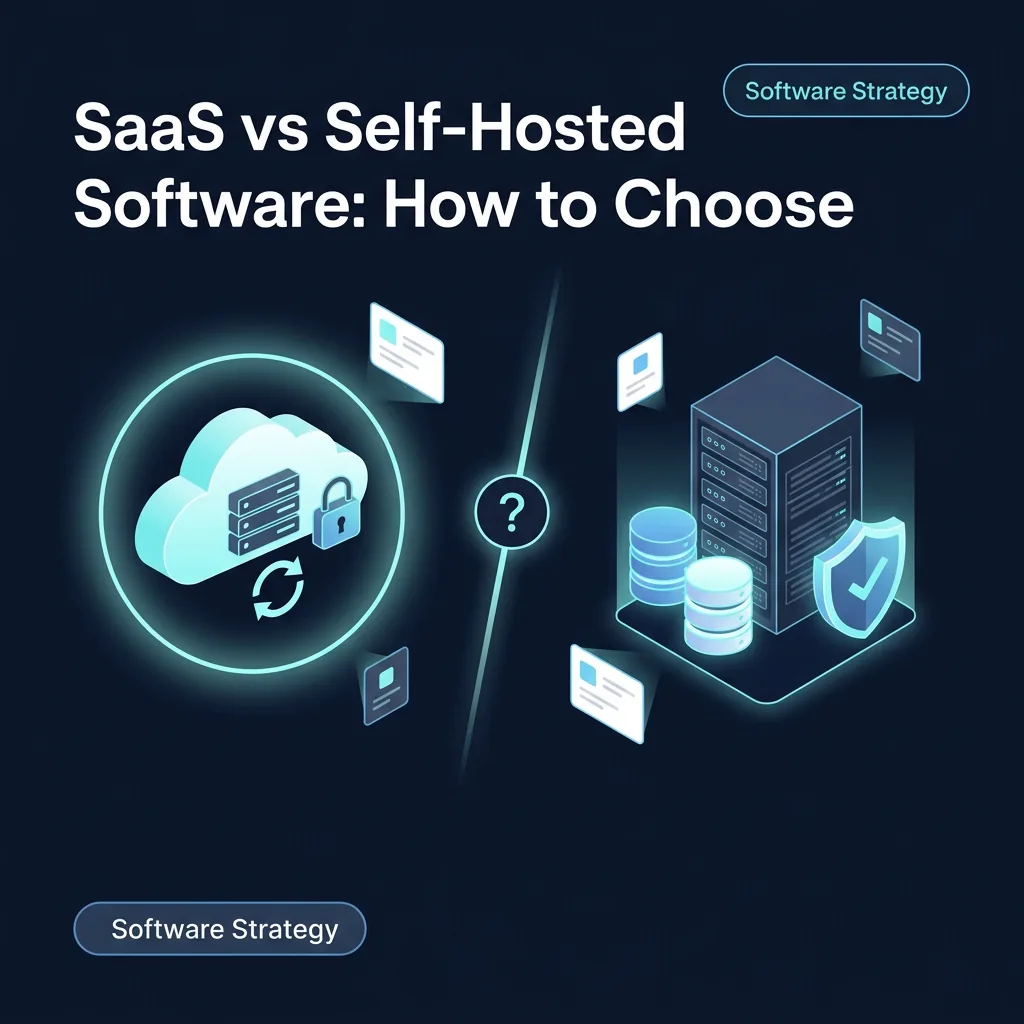
When a business evaluates new software, one of the earliest decisions is whether to use a cloud SaaS product or deploy a self-hosted solution on their own infrastructure. This choice has significant downstream implications for cost, data control, customisation flexibility, and operational complexity.
Both models have legitimate use cases. The right answer depends on your specific situation — not a general preference for one architecture over another.
What SaaS Actually Means
SaaS (Software as a Service) means the software runs on the vendor's infrastructure. You access it through a browser or API. The vendor manages updates, backups, security patches, and uptime.
What you get with SaaS:
- Zero infrastructure management
- Automatic updates and security patches
- Predictable monthly costs
- Immediate deployment (no setup time)
- Vendor-managed compliance in many cases
What you give up:
- Control over data location and residency
- The ability to customise beyond what the vendor offers
- Independence from vendor pricing decisions
- Continuity if the vendor discontinues the product
What Self-Hosted Actually Means
Self-hosted (also called on-premise or private cloud) means the software runs on servers you control — whether physical hardware, your own cloud VMs, or a managed server from a hosting provider.
What you get with self-hosted:
- Full data control and residency
- Deep customisation capability
- One-time or flat licensing costs (in many cases)
- No dependency on vendor uptime
- Ability to air-gap the deployment for high-security environments
What you give up:
- You own infrastructure management, updates, and security
- Higher upfront setup cost and ongoing DevOps overhead
- Slower path to new features (manual update process)
The Industries Where Self-Hosted Wins
Self-hosting makes the most practical sense in a specific set of circumstances:
Regulated data environments. If your business handles financial records, healthcare data, or government contracts with specific data residency requirements, self-hosting gives you direct control. You know exactly where the data lives.
High-volume, low-latency requirements. When a system needs to process thousands of events per second and response time is critical, self-hosting eliminates the network round-trip to a vendor's cloud.
Deep customisation needs. If the product needs to reflect your specific business logic in ways that a generic SaaS product cannot accommodate, self-hosting (with access to the source or a configurable build) is the only path.
Cost at scale. SaaS pricing is usually per-seat or per-transaction. At a certain scale — typically 50–100+ users — the monthly SaaS cost exceeds the cost of running equivalent infrastructure plus maintenance.
The Industries Where SaaS Wins
SaaS is the right default for the majority of small and mid-market businesses because the operational overhead of self-hosting is real and significant.
Early-stage businesses. When a company is still finding its workflow, the flexibility to switch tools without sunk infrastructure costs is valuable. SaaS makes pivoting cheaper.
Small teams without technical staff. Managing a self-hosted deployment requires someone who can handle server maintenance, updates, and incident response. If no one on the team has that expertise, SaaS eliminates the risk.
Globally distributed teams. Cloud SaaS is available from anywhere. Self-hosted systems require VPN or public-facing endpoints, both of which add complexity.
Compliance-validated SaaS. For many compliance frameworks, using a SOC 2 Type II certified SaaS provider is easier to audit than a self-hosted deployment where you are responsible for the full compliance posture.
The Hybrid Model: SaaS Interface, Self-Hosted Data
An emerging pattern that works well for many mid-market businesses is a hybrid architecture: a SaaS-style managed application layer combined with a self-hosted data store. The vendor manages the application; the client controls the database.
This approach addresses the main concern about SaaS data residency while retaining the operational simplicity of a managed application. It requires vendor support, but a growing number of enterprise and mid-market software vendors offer it.
How Ibistra Tech Approaches This
All three Ibistra Tech products — Boutica, FabTrack, and FieldTrack — are available as both cloud SaaS and self-hosted deployments. We made this decision because the businesses we serve sit on both sides of the line.
A boutique garment enterprise with five staff and no IT team benefits from the SaaS deployment: minimal setup, no maintenance, always current. A larger textile manufacturer with data residency requirements or existing infrastructure investment benefits from self-hosted.
The application code is identical. The deployment model is a configuration choice, not an architectural one.
A Decision Framework
Use this to guide the SaaS vs self-hosted decision:
| Factor | Points toward SaaS | Points toward Self-Hosted |
|---|---|---|
| Team technical expertise | Low | High |
| Data residency requirement | No | Yes |
| User count (current) | Under 30 | Over 50 |
| Customisation need | Standard workflows | Highly specific logic |
| Budget preference | Predictable monthly | One-time capital cost |
| Compliance posture | Vendor-certified | Full control required |
If you score four or more points toward SaaS, start there. You can always migrate to self-hosted later. The reverse is more expensive.
If you are evaluating a SaaS product that you may eventually want to bring in-house — or if you are an early-stage SaaS founder deciding on architecture — our SaaS Product Consulting service covers the architectural decisions that affect this choice most.
Ibistra Tech builds software available in both deployment models. To discuss which is right for your business, contact us.