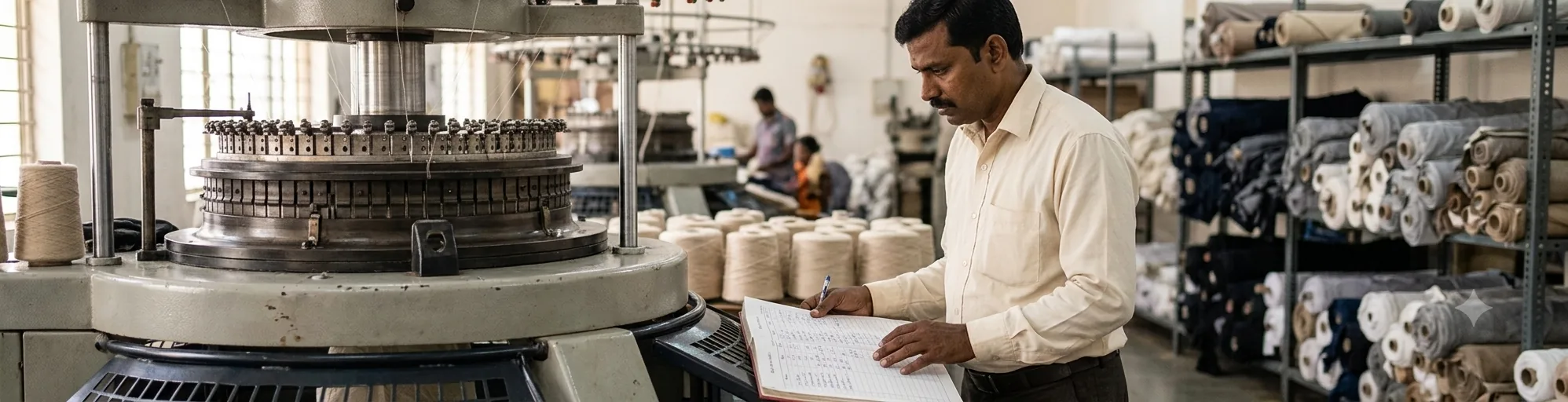
Ask a production manager at a knitting or fabric manufacturing unit how they track a job from yarn receipt to fabric delivery, and the honest answer is usually some combination of a register, a few spreadsheets, and whatever the machine operators remember to write down. It works, in the sense that the fabric does get produced. It does not work in the sense that nobody can answer, on demand, exactly how much yarn is unaccounted for on a given job.
That gap — between "the work is getting done" and "the work is visible" — is exactly what a purpose-built textile yarn tracking system closes.
Why Spreadsheets Break Down on the Production Floor
Spreadsheets fail at textile production tracking for a specific reason: the data doesn't originate in one place. Yarn inward gets logged by the store. Knitting programs get assigned by the floor supervisor. Machine output gets recorded, if at all, by the operator. Fabric delivery gets noted separately by dispatch. By the time someone tries to reconcile all of it into a single picture of "where did this job's yarn go," the numbers rarely agree, and nobody has time to figure out why.
The result is a production manager who can tell you a job is "mostly done," but not precisely how much yarn was used, returned, or is still unaccounted for — until a physical stock count eventually surfaces the discrepancy, often weeks later.
What a Real Yarn and Production Tracking System Needs
A system built for textile production — rather than adapted from generic inventory software — needs to model the actual lifecycle of a job, not just its inputs and outputs:
Job-to-program linking. A single production job often spans multiple knitting programs, each with its own machine, diameter, fabric type, GSM, and stitch length. Tracking needs to happen at the program level and roll up to the job, or the detail that actually explains output differences gets lost.
Full yarn lifecycle tracking. Every kilogram of yarn should be traceable from inward receipt (with mill, delivery challan, and quality notes) through what's issued to production, and back through any returns. Running balances need to update automatically — not require a manual reconciliation at month-end.
Automatic job completion. When fabric delivered plus yarn returned equals total yarn received, the job is done. A system that can calculate this automatically removes the need for someone to manually chase down whether a job is actually finished or just looks finished.
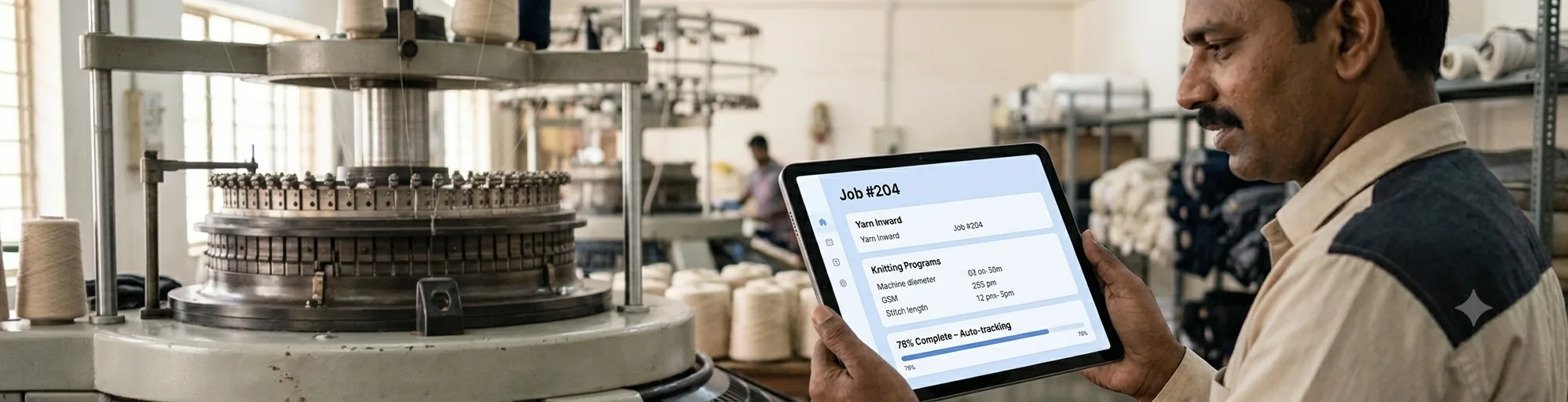
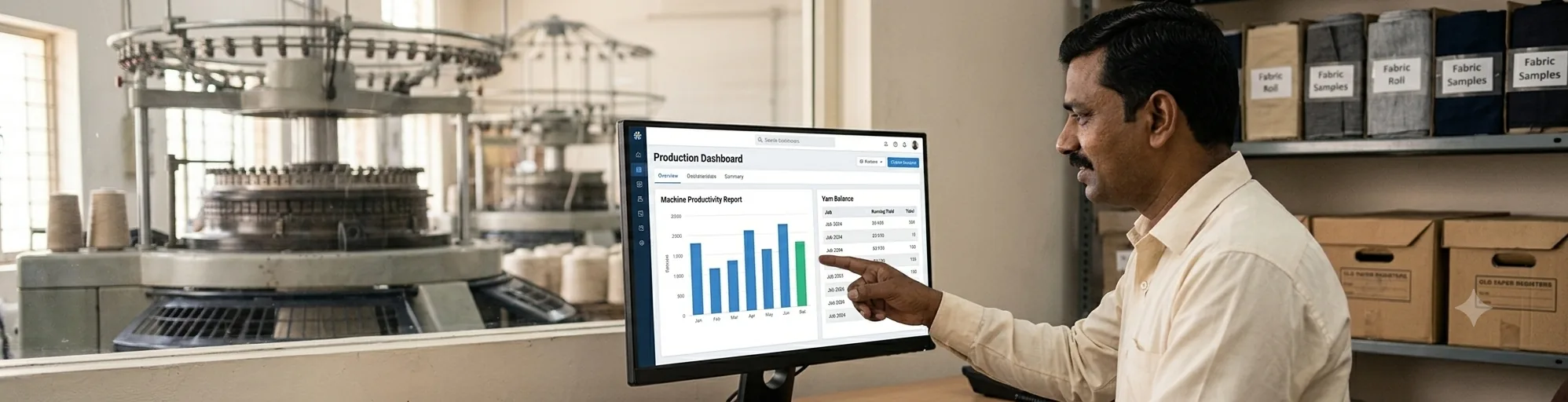
Machine and employee productivity data. Which machines are producing at expected output, and which are underperforming or due for maintenance? Which employees or shifts are consistently more productive? Without this data captured as a byproduct of daily operation, these questions only get answered when something has already gone wrong.
Quality grades on delivery. Fabric delivery records should capture quality grade at the point of delivery, not as a separate inspection process disconnected from the job record.
Maintenance schedules tied to actual usage. Machine downtime is expensive and often preventable. Maintenance scheduling that's tied to the machine's actual production history — not a generic calendar reminder — catches more issues before they cause a stoppage.
The Cost of Not Tracking This
The cost of running production on spreadsheets is rarely visible as a single number, which is exactly why it persists. It shows up as:
- Yarn discrepancies that only surface at physical stock count, long after the job that caused them is finished
- Machine underperformance that goes unnoticed until output targets are consistently missed
- Time spent reconciling inward, production, and delivery records across disconnected sources
- Maintenance that happens reactively, after a breakdown, instead of on a schedule informed by actual usage
None of this is a single dramatic failure. It's a steady tax on production efficiency that compounds as job volume grows.
Building This as a Purpose-Built System
We built FabTrack to manage this full lifecycle in one place — job and program management, yarn inward and return tracking with automatic balances, machine and employee productivity reporting, and maintenance scheduling, all connected rather than reconciled after the fact. Jobs auto-complete when the numbers actually close, so "is this job done" stops being a question someone has to chase down.
If your production tracking currently lives across a register and a handful of spreadsheets, the test is simple: could someone answer, right now, exactly how much yarn is unaccounted for on your current highest-volume job? If the honest answer takes more than a few minutes to work out, that's the gap a purpose-built system closes.
Ibistra Tech builds FabTrack, a production management system for textile and fabric manufacturers. Talk to us about your production floor.