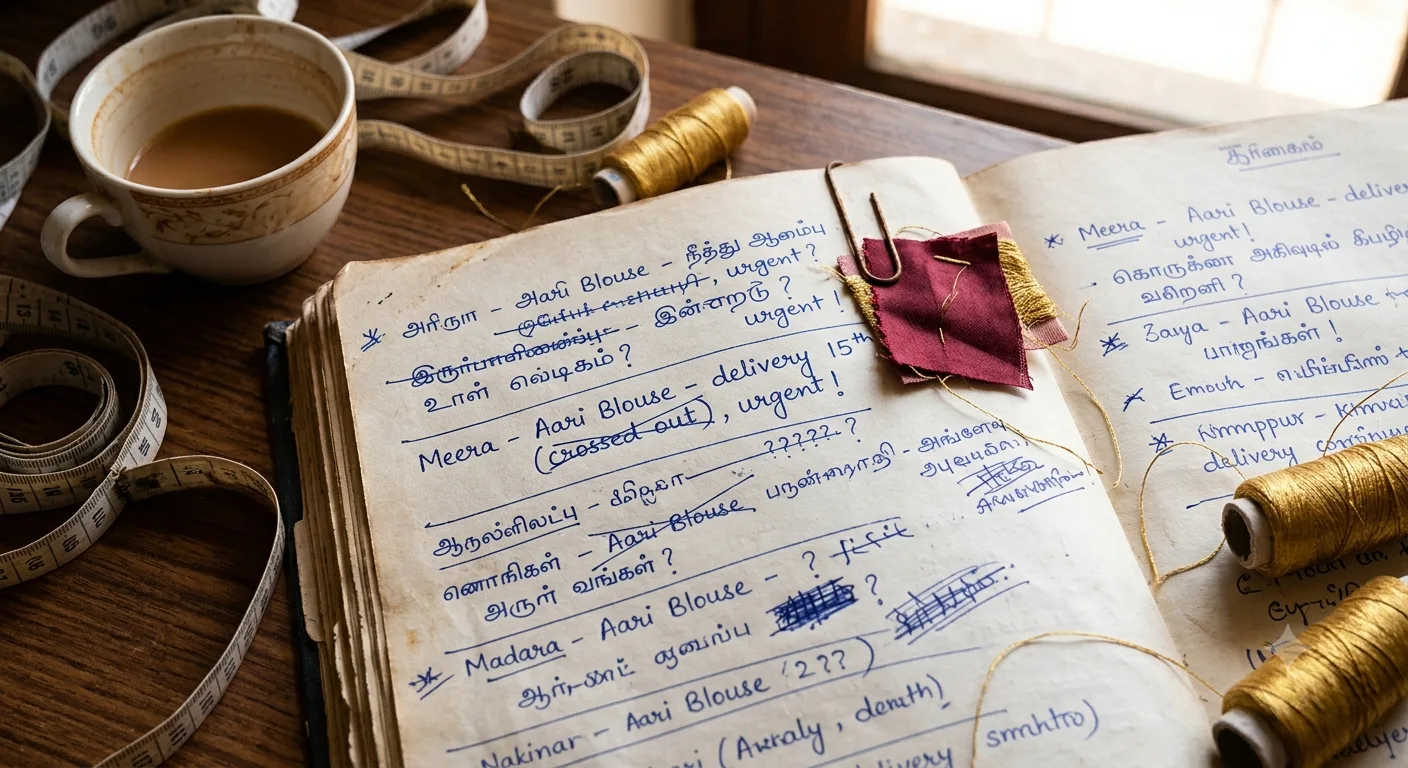
Most boutiques and tailoring studios start with a notebook, and for a while, it works. The owner knows every customer, every order, every deadline. Then order volume grows past what one person can hold in their head, and the notebook stops being a system — it becomes a bottleneck. Choosing the right boutique order tracking software at that point is less about features and more about matching a system to how tailoring work actually happens.
We ran into this ourselves as customers of a Tirupur bridal studio — unable to get a straight answer on our own order's status — which is what eventually led us to sit down with them and understand the problem properly.
The signs are familiar to anyone running a busy boutique: a customer calls to ask about their order, and finding the answer means flipping back through pages. A dress goes missing between the cutting table and the fitting room and nobody can say whose it was. A customer picks up their outfit at a trial without paying in full, and three weeks later no one remembers to follow up.
None of this is a staffing problem. It is a tracking problem — and it's worth understanding what actually fixes it before spending money on software that doesn't.
Why Generic Software Doesn't Fit
Generic inventory or invoicing software rarely fits a tailoring business, because the unit of work isn't a product on a shelf — it's an order with stages, measurements, staff assignments, and a customer relationship attached to it. Retail inventory tools track stock counts. A boutique needs to track progress on individual, one-off pieces of work, several of which might be in flight for the same customer at once.
That mismatch is why so many boutiques end up back on notebooks or spreadsheets even after trying an off-the-shelf tool — the software's data model doesn't match how the business actually operates.
What to Actually Look For
If you're evaluating order tracking software for a boutique or tailoring business, these are the capabilities that matter — not because they sound good on a features list, but because they're the ones that fail silently when missing:
Item-level order status. A single customer order might include a blouse, a lehenga, and a matching dupatta, each at a different stage. If the software only tracks status at the order level, "in progress" tells you nothing useful.
Staff work logs. When multiple tailors work on the same order, the system needs to know who did what — both for accountability and for accurate wage calculation. Paying staff by the piece or by the day only works if the work itself is logged somewhere reliable, not reconstructed from memory at the end of the week.
Customer measurements, stored once. Repeat customers shouldn't need to be re-measured every visit. Measurements tied to a customer profile save time and reduce fitting errors — and they turn a one-time customer into a faster repeat transaction.
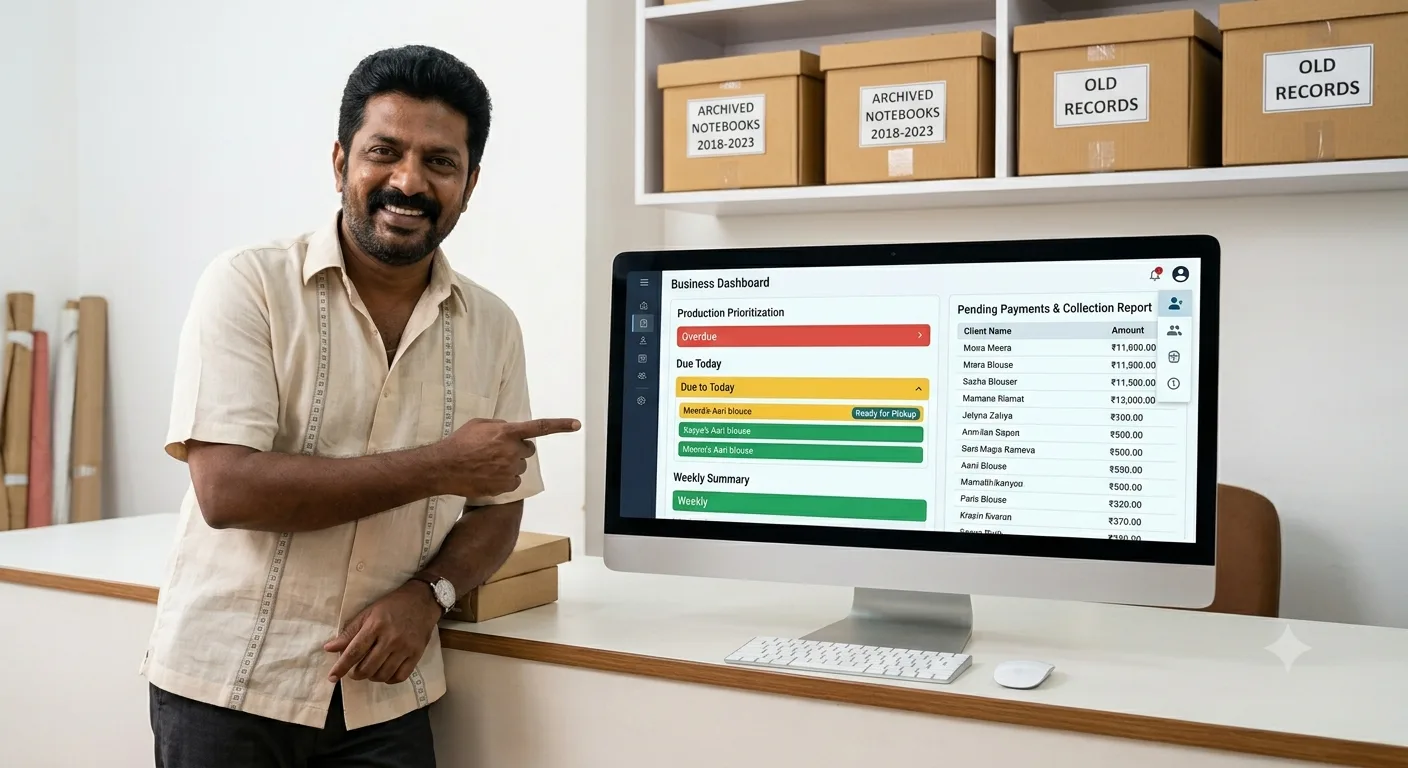
Payment and pending-payment tracking. This is the one boutiques underestimate most. Customers often collect an item at a trial fitting without paying the full balance, fully intending to pay later — and "later" quietly becomes never, unless someone is actively tracking exactly who owes what. Software that doesn't surface this as its own report tends to let it go unnoticed until it's a real revenue gap.
Material reference photos. With multiple orders in progress at once, a quick photo of the fabric or design attached to the order removes the ambiguity of "whose dress was whose" — a small feature that solves a surprisingly common problem.
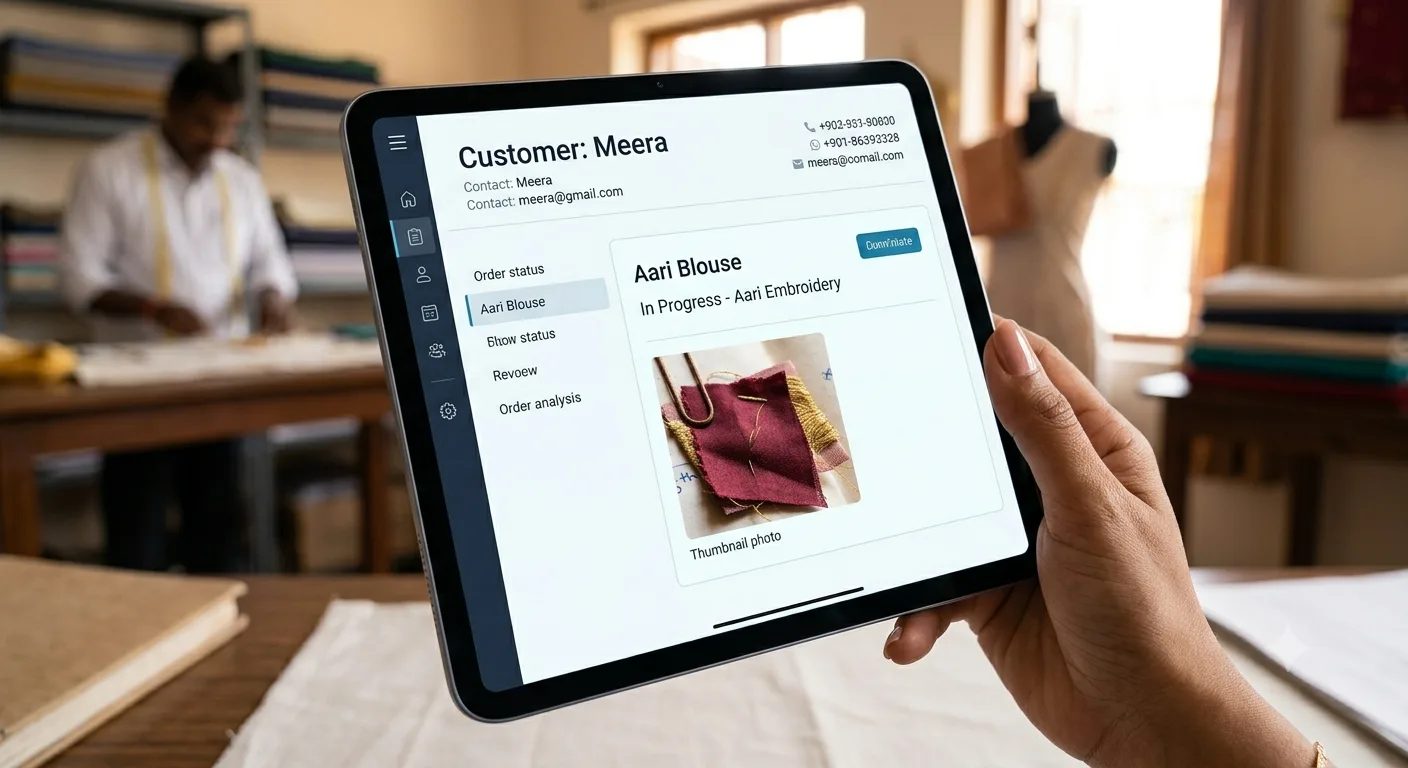
Automatic customer updates. A customer who gets a WhatsApp message when their order is ready doesn't need to call and ask. That single change removes a large share of the anxious follow-up calls a busy boutique fields every day.
Role-based access and audit logs. As staff count grows, not everyone needs to see or edit everything. Who marked an order complete, who recorded a payment, who has access to financial reports — these should be answerable questions, not assumptions.
Signs Your Boutique Has Outgrown the Notebook
You likely don't need to make this decision in the abstract — the signals are usually already present:
- Customers regularly call to ask about order status because there's no way to tell them proactively
- Staff wages are calculated from memory or informal tallies rather than logged work
- At least one order has gone temporarily "missing" in the sense that nobody could immediately say what stage it was at
- Pending payments are tracked informally, if at all, and some are quietly written off
- Growth in order volume feels like it's making the business harder to run, not easier
If two or more of these are true, the cost of staying on notebooks is no longer invisible — it's just undistributed, spread thin across staff time and customer trust rather than showing up as a single line item.
Off-the-Shelf, or Purpose-Built?
Generic retail POS or inventory software will get you basic order entry and invoicing, and for a small operation that's sometimes enough. Where it breaks down is exactly the list above — item-level tracking, staff work logs, and pending-payment visibility are rarely first-class features in software built for general retail, because that's not the problem it was designed to solve.
We built Boutica specifically around how boutique and tailoring businesses operate, after seeing this gap firsthand. For a look at how it played out for one bridal wear and custom stitching studio, see our Boutica case study.
Ibistra Tech builds Boutica, a boutique and tailoring management system. Talk to us about your boutique.