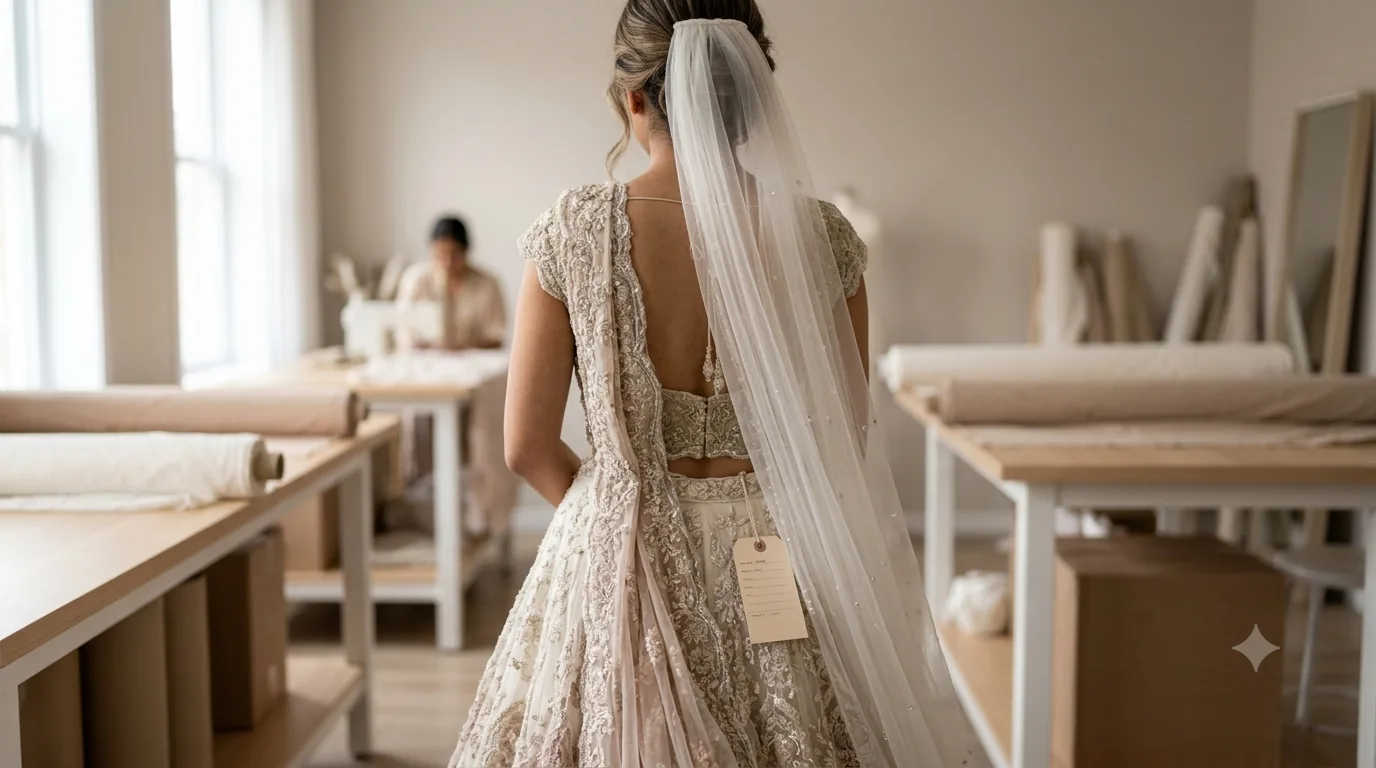
Every bridal customer says some version of the same thing when she books her order.
"The wedding is on the 14th. I need everything ready by the 10th for the photoshoot."
That date doesn't move. There's no "can we push it by a week" conversation — the wedding happens on the 14th whether the lehenga is ready or not.
And yet, across tailoring boutiques, bridal orders miss deadlines more often than any other order type.
Not because boutiques don't care. Because a bridal order isn't one order — it's five to eight separate garments sharing one immovable date. More garments, more fittings, more fabric to track, more at stake — all competing for the same tailors and the same time as thirty regular orders in the pipeline.
Here's what actually goes wrong, and how to close each gap.
The Real Reason Bridal Orders Miss Deadlines
It's rarely one big failure. It's several small gaps failing at the same time — each one small enough to ignore, until deadline week.
| What breaks | Why it happens |
|---|---|
| Garments finish out of sync | Blouse to one tailor, inner skirt to another, dupatta embroidery outsourced — nobody tracks all three as one delivery commitment. Two finish on time, one doesn't, and the trial happens with an incomplete outfit. |
| Fitting notes go stale | First fitting is marked on paper. Second fitting's paper goes missing. The tailor works from memory or the original measurements. The third fitting reveals the mismatch. |
| Customer fabric loses its trail | The bride brings her own silk. It's noted "somewhere." Two weeks later, nobody remembers how much came in or where it's stored. |
| The balance payment gets awkward | Deposit collected upfront, balance due on delivery — but the collection conversation gets delayed at handover, then forgotten. |
Individually, each gap looks minor. Together, they're why bridal orders are the ones most likely to end in an unhappy customer — or a panicked final week where three tailors get pulled off other work to rescue one order.
Step 1: Treat Every Garment as a Separate Commitment
A bridal order is a lehenga. A blouse. A matching inner. A dupatta. Sometimes a reception saree. Sometimes a groom's kurta.
Each piece has its own cutting, stitching, and finishing stage. Each may go to a different tailor. Each has to be ready before the final trial — not just "the order," as a whole.
When all of it sits under one order entry, visibility disappears the moment work gets distributed. You can't see that the lehenga is done, the blouse is in stitching, and the inner hasn't been cut — not without walking to the workroom and asking.
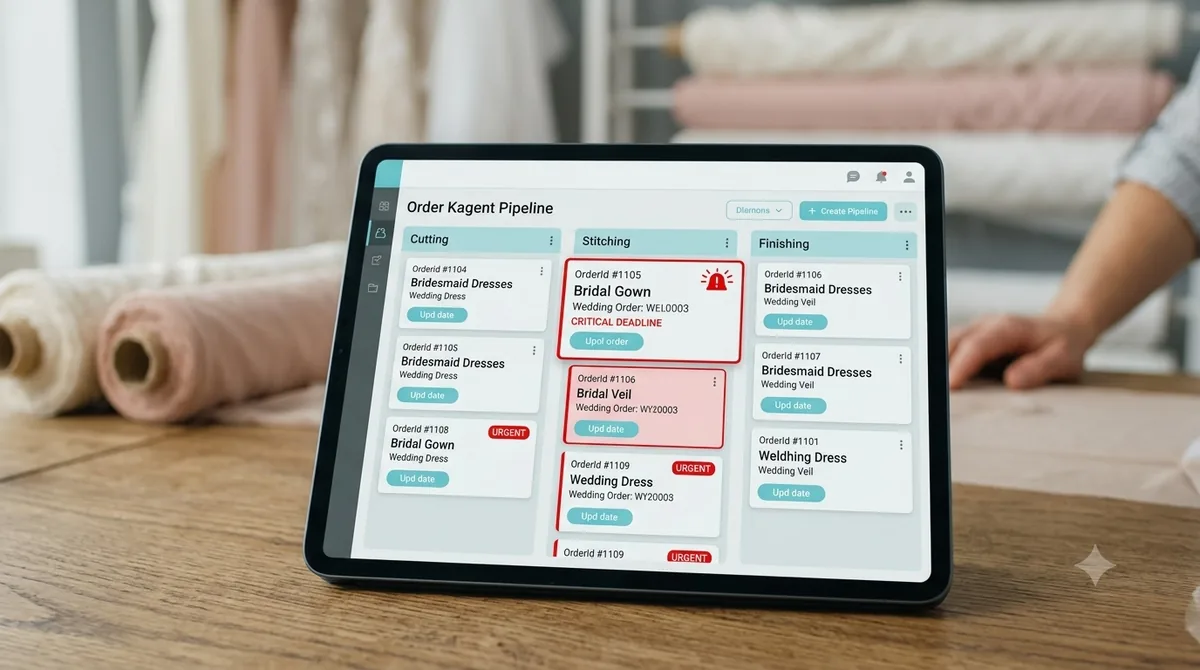
Item-level tracking gives each garment its own status. Three garments, three tracked items, each with its own stage, visible from one screen. You know exactly which piece is the blocker before it becomes a crisis.
Step 2: Version Every Fitting — Not Just the First Measurement
Bridal customers come in for multiple fittings. That's the nature of the work.
- First fitting: full measurements taken, initial notes.
- Second fitting: blouse comes in at the waist, sleeve length adjusted.
- Third fitting: minor finishing tweaks before delivery.
In most boutiques, each set of notes lives somewhere different — the first measurement in a notebook, the second on a paper pinned to the garment, the third in a WhatsApp message to the senior tailor. By the time finishing work starts, the tailor is guessing which version is current.
The fix is measurement versioning: every set of changes saved against the same customer profile, timestamped, and tagged to the right garment, so the tailor always works from the latest version. It also protects the boutique — if a customer disputes a fit after delivery, there's a record of every fitting, every adjustment, and who signed off.
Step 3: Track Customer-Provided Fabric From Day One
Bridal customers often bring their own fabric, and it matters enormously to them — silk sourced from a specific place, an heirloom piece, imported material, embroidered cloth that can't be replaced if there's a cutting error.
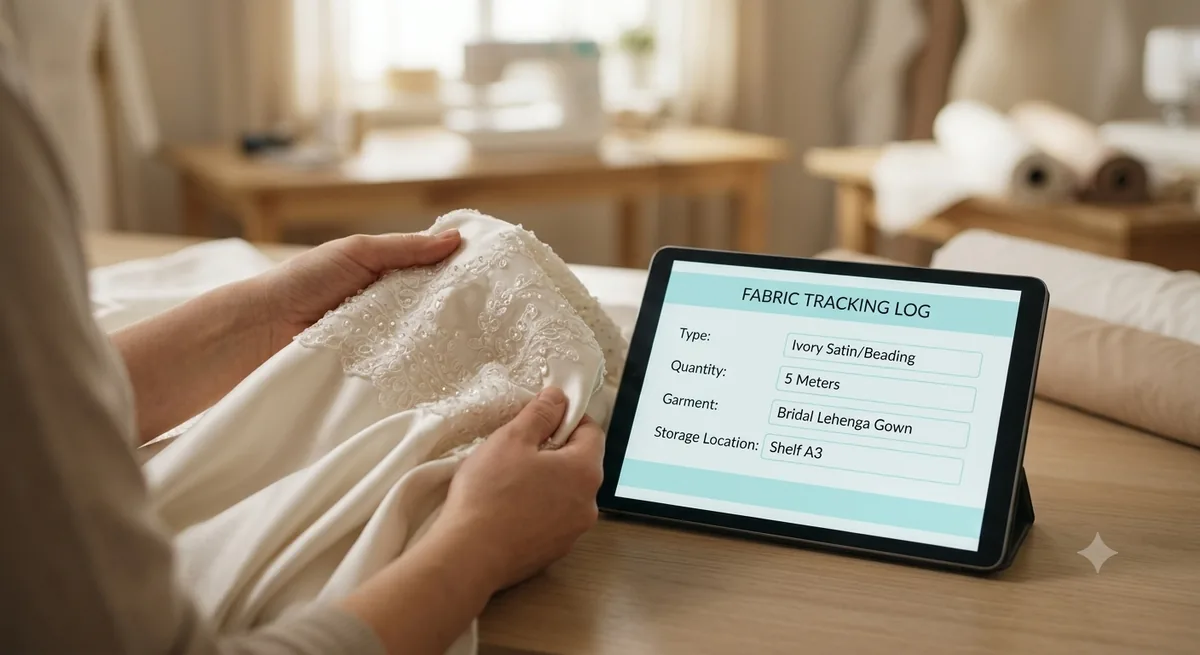
When that fabric arrives, it needs to be logged immediately: what it is, how much came in, which garment it's for, where it's stored. Not on a loose slip of paper that's unreadable in three weeks.
Tracked digitally against the order, anyone in the shop can check what came in and where it is. Cutting decisions get made with that record in front of them — not a guess.
Step 4: Build the Pipeline Around the Wedding Date, Not Today's Workload
Most boutiques plan bridal work the same way: take the order, make a mental note that it's important, and assume it'll get done in time. That assumption is what breaks things.
A pipeline dashboard shows every garment, every stage, every assigned tailor — across every order in the shop, not just one. When a bridal lehenga is visibly queued behind twelve other garments, that's a deadline problem you can see weeks in advance, while there's still time to redistribute work, bring in capacity, or sequence the bridal order earlier.
Without that visibility, the first sign of trouble is usually the customer calling a week before the wedding. At that point, the only options left are bad ones.
The pipeline turns "I hope we'll make it" into "I can see we'll make it." That's the entire difference between a confident boutique and a stressed one.
Step 5: Don't Let the Balance Payment Get Awkward
Bridal orders involve real money — large deposits upfront, balance due on delivery. When payments aren't tracked clearly, the balance collection either becomes an uncomfortable conversation or gets skipped entirely, because handover is hectic and nobody remembers to raise it.
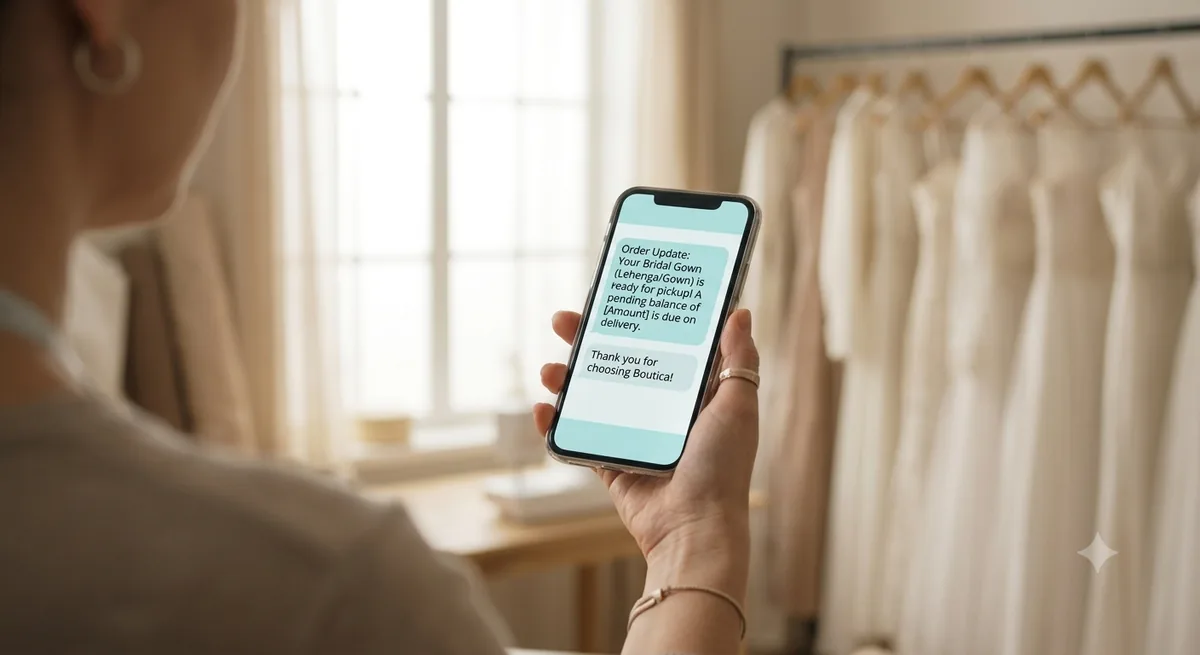
Every bridal order should carry a linked invoice from the moment it's created: deposit recorded, balance visible. When the garment is ready and the customer comes to collect, the outstanding amount is already there — nobody has to calculate or remember it. An automatic WhatsApp update at "ready for pickup," with the balance included, removes the awkwardness before the conversation even starts.
The Same Problem, Smaller Scale
Bridal orders are the most visible version of this challenge, but every custom-stitching order shares the same structure — a churidar with a matching blouse, a saree blouse with a specific neck design, three kurtas for a family event. Any order with multiple garments, specific measurements, a fixed date, and a customer who cares about the outcome is a smaller version of the bridal problem. The scale differs; the management gaps are identical.
Bridal customers don't just want beautiful clothes — they want confidence that measurements won't be lost, fittings will be progressive rather than repeated from scratch, and the outfit will be ready before the wedding, not the night before. That confidence doesn't come from working harder. It comes from working with visibility into every garment, every fitting, and every rupee still owed.
Frequently Asked Questions
Why do bridal orders miss deadlines more than regular orders?
A bridal order bundles multiple garments — lehenga, blouse, inner, dupatta, sometimes more — into one fixed, non-negotiable date. Each garment can be at a different stage with a different tailor, and if they aren't tracked as separate commitments, one lagging piece can hold up the entire delivery without anyone noticing until it's too late.
How should a boutique track multiple garments in one bridal order?
Each garment should be logged and tracked as its own item — with its own cutting, stitching, and finishing stage — rather than as one line item for the whole order. That way a manager can see at a glance which specific piece is the bottleneck instead of only knowing the order as a whole is "in progress."
What's the best way to manage bridal fitting notes across multiple visits?
Every fitting's adjustments should be saved against the customer's profile, timestamped, and tagged to the exact garment — not scattered across a notebook, a pinned paper slip, and a WhatsApp message. This is often called measurement versioning, and it ensures the tailor always works from the latest, correct set of changes.
How do boutiques avoid awkward balance-payment conversations on bridal orders?
By linking an invoice to the order from the start, recording the deposit, and keeping the balance visible at every stage. An automatic notification when the garment is ready for pickup — with the balance included — lets the customer see what's owed before she arrives, so nobody has to raise it in person.
See How Boutica Handles Bridal and Custom Orders
Boutica tracks every garment individually, versions measurements across fittings, records customer-provided fabric, and shows the full pipeline for every order in your shop — from one screen.
Built for tailoring boutiques with staff. Not a generic tool retrofitted for stitching work. At Mahesh Designer's Tiruppur, a bridal wear and custom stitching studio, this shift moved order tracking, payment follow-up, and prioritization off notebooks entirely — replacing "whoever called loudest" with a daily view based on real delivery dates.
Ibistra Tech builds Boutica, a boutique and tailoring management system built around how tailoring shops actually operate. Talk to us about your shop.