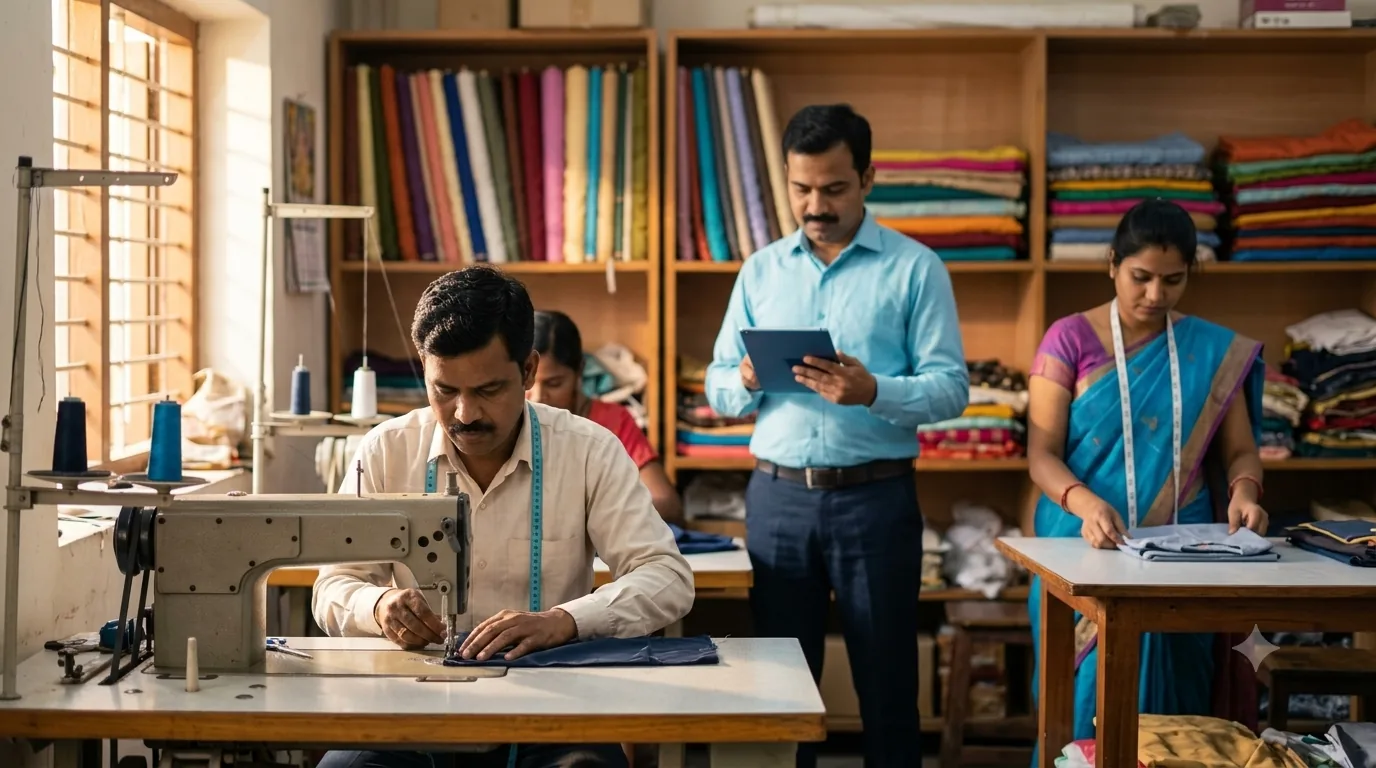
Running a tailoring shop sounds straightforward from the outside.
Customer comes in. Measurements are taken. Garment is stitched. Customer collects. Done.
But if you actually run one — with tailors, a manager, packaging staff, and delivery — you know the reality is nothing like that.
Orders pile up. Measurement notebooks go missing. A tailor finishes one blouse from a set of three and nobody knows what happened to the other two. A customer calls for the fourth time this week asking if her dress is ready. A delivery is late because the garment was marked done but nobody told the packaging team.
This isn't a skill problem. Your tailors are skilled. This is a management problem — and most tailoring shops run without any real management system at all. In our work building order tracking software for boutiques, we've seen this pattern repeat across shops of every size. Here's how to fix it.
The Real Problem: Information Lives in Too Many Places
Walk into most tailoring shops and you'll find the same setup.
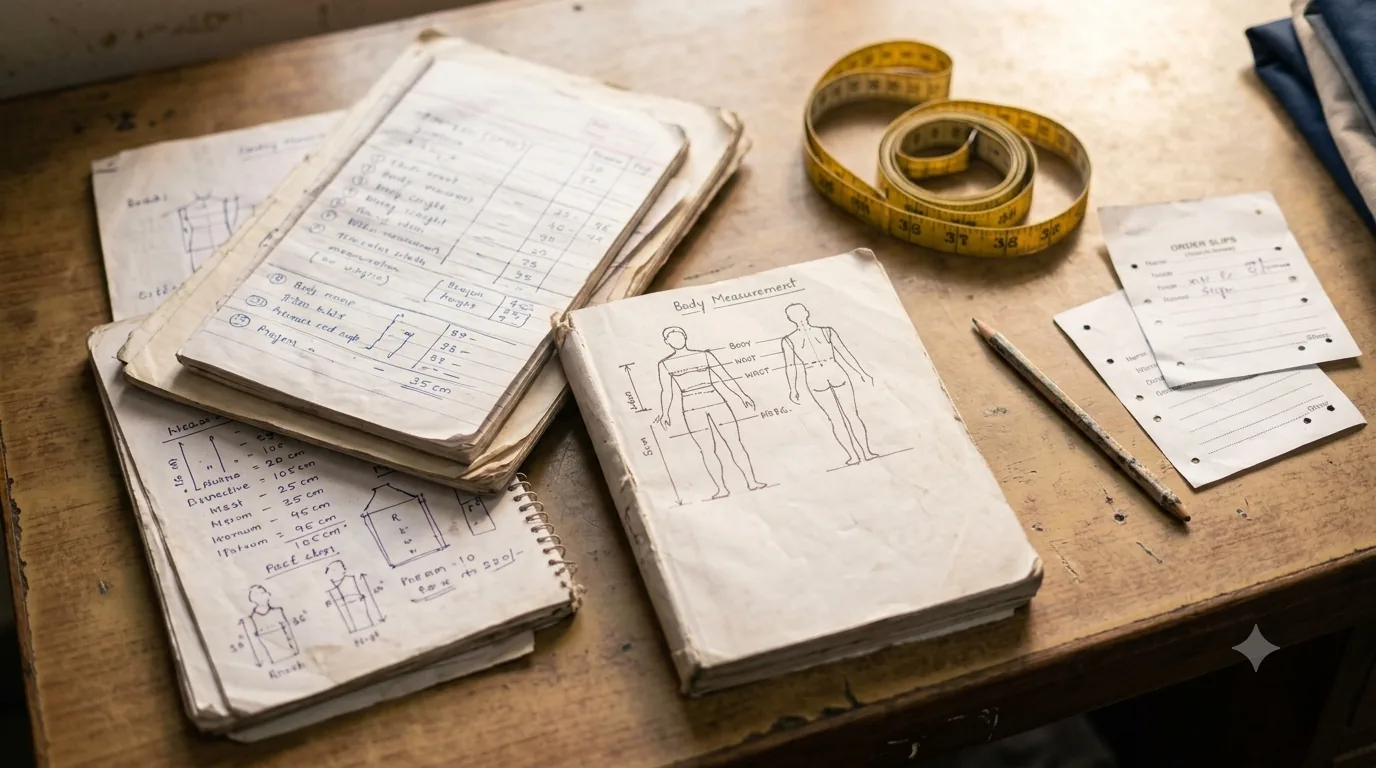
Measurements are in a notebook — or five notebooks, because the first one got full, and the second one is somewhere on the cutting table, and the third one belongs to the senior tailor who keeps it at home.
Order status lives in the manager's head. Or on a whiteboard. Or in a WhatsApp group where messages scroll past and get forgotten.
Delivery dates are written on paper slips pinned to garments. Which fall off.
When everything is scattered across notebooks, WhatsApp threads, and people's memories, the manager's entire day becomes detective work. Where is this order? Who has those measurements? Is that dress ready?
That detective work is what stops your shop from scaling — not the lack of skilled tailors.
Step 1: Give Every Garment Its Own Identity
The first shift in thinking: stop tracking orders. Start tracking garments.
A customer orders three blouses. That's not one order. That's three separate pieces of work, each at a different stage, each assigned to a different tailor, each with its own delivery expectation.
When you track all three under a single "order of qty 3," you lose visibility. One blouse might be ready. One might be in stitching. One might not have been cut yet. You have no way to tell without physically walking to the workroom and asking.
Item-level tracking means every garment gets its own status. You know exactly where each piece is at any moment. When a customer calls, you have a real answer — not "let me check and call you back."
Step 2: Stop Relying on the Measurement Notebook
The measurement book is the single biggest operational risk in a tailoring shop.
It gets lost. It gets wet. A page tears. A new staff member can't read the handwriting. The customer returns after eight months for an alteration and the measurements are in a notebook that's now under three other notebooks from last festive season.
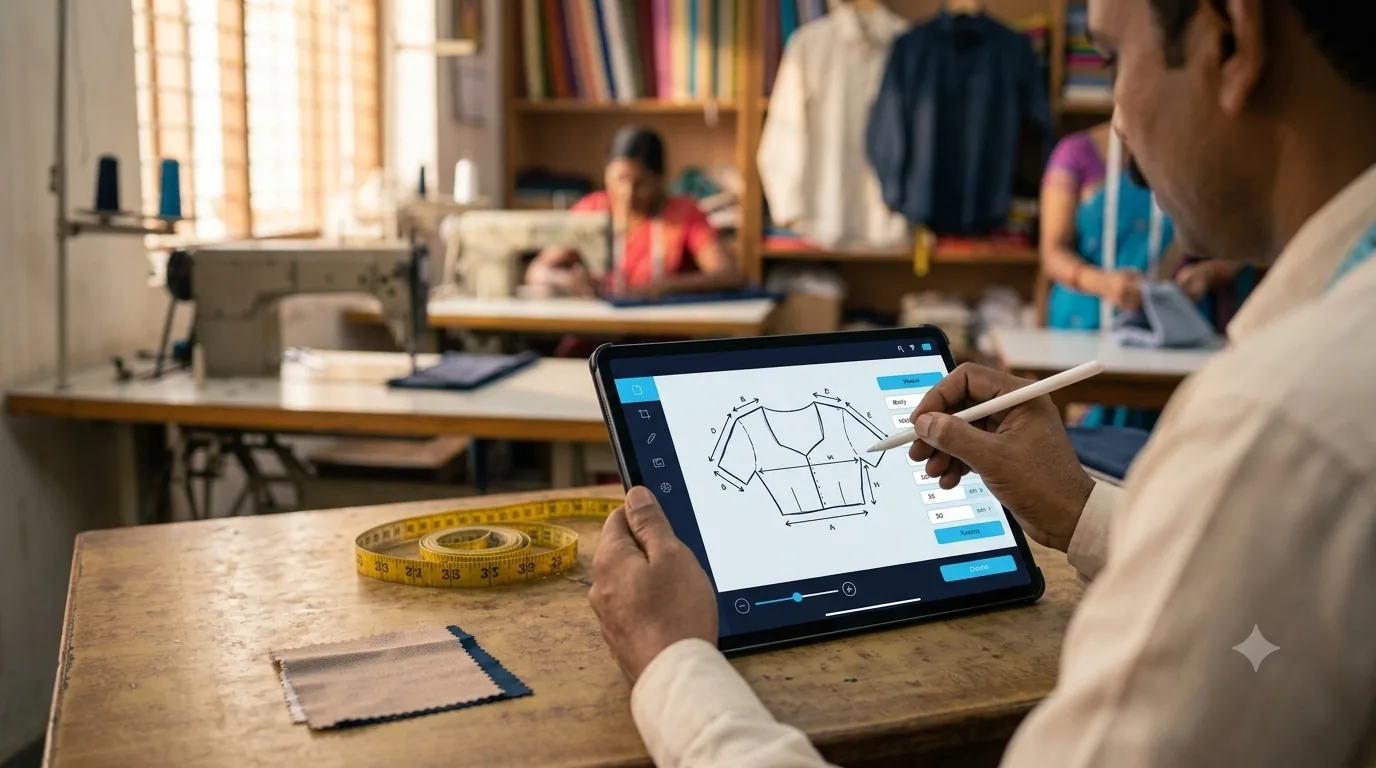
Going digital doesn't mean typing numbers into spreadsheet boxes. Tailors shouldn't have to change how they work. A measurement drawing is a skill — the sketch, the reference points, the notes on the side. That needs to be preserved, not replaced with a form.
The right system lets tailors draw measurements on screen the way they always have. The sketch is then tagged to the right customer and garment type, versioned, and retrievable in seconds — even two years later.
No lost books. No re-measuring. No awkward calls to the customer asking them to come in again because you can't find their records.
Step 3: Make the Pipeline Visible to Everyone
In most tailoring shops, the owner or manager is the only person who knows the full picture. Everyone else knows only their own piece.
The tailor knows she's stitching three blouses. She doesn't know there are twelve other garments queued behind her.
The packaging staff knows what landed on their table today. They don't know what's coming tomorrow.
The manager knows everything — and is therefore the bottleneck for every decision.
A pipeline dashboard changes this. Picture a board: Queued → In Progress → Ready → Delivered. Every garment sits in its current stage. Filter by tailor. Filter by team. See at a glance where things are moving and where they're stuck.
When a new order comes in and you have forty garments in the pipeline, you can actually see whether your team has capacity this week — or whether you need to push the delivery date before you confirm the order.
That's the kind of visibility that prevents missed delivery dates.
Step 4: Let Customers Know Without You Lifting a Finger
"Is my blouse ready?"
If that question comes to your shop more than twice a day, it's a sign of a gap in your process — not a sign of difficult customers.
Customers call because they have no other way to know. The solution isn't to hire someone to answer those calls. It's to stop those calls from happening.
Automatic notifications — sent by WhatsApp or email at each stage — do this. Order confirmed. Work started. Ready for pickup. Payment pending.
Customers feel informed, and your staff spend less of the day being pulled off the table to answer the same question. At Mahesh Designer's Tiruppur, a bridal wear and custom stitching studio, automatic WhatsApp notifications for order pickup and invoicing were one of the operational changes that came out of moving off notebooks — freeing the owners to focus on production instead of fielding status updates.
Step 5: Assign Work Clearly — and Make Sure Everyone Knows Their Piece
Ambiguity kills momentum in a tailoring shop.
"Someone take care of this" is not an assignment. When work isn't clearly assigned, it sits. When responsibility isn't clear, things fall through the cracks.
The fix is a system where every garment has a named person at every stage. This tailor cuts. This tailor stitches. This person packages. This person delivers.
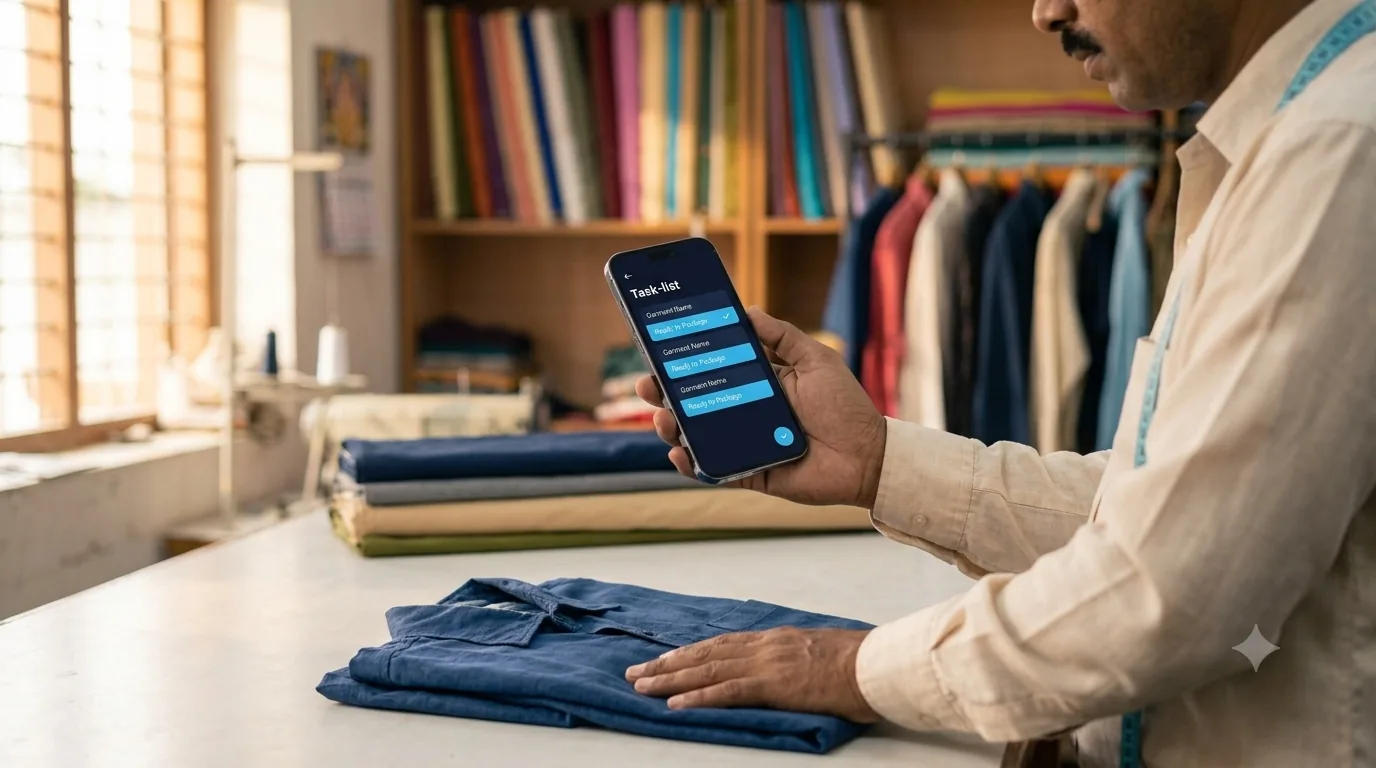
Everyone logs into the same system — from their phone, without needing to download anything — and sees only what's assigned to them. When a garment moves from stitching to packaging, the packaging team knows. They don't need to wait for someone to walk over and tell them.
Tailors shouldn't need training to use this. The mobile view should be simple: here's your list, here's the garment, mark it done when it's done. That's it.
Step 6: Track Money the Same Way You Track Garments
Pending payments are a quiet drain on most tailoring shops.
Customers pay a deposit upfront, collect the garment, and the balance gets forgotten — by them and sometimes by the shop too. It's not intentional. It just gets lost in the volume. At Mahesh Designer's Tiruppur, this turned out to be one of the most valuable reports the owners use: customers would sometimes collect a dress at a trial fitting without paying in full, and without a dedicated pending-payments view, those balances were genuinely hard to follow up on.
A system that generates GST-compliant invoices from orders, records full and partial payments, and shows you a clear list of pending amounts means nothing falls through. You know who owes what. You can follow up confidently.
For shops in India, GST compliance built into the billing process also removes the manual calculation step that slows down invoicing.
The Honest Truth About Going Digital
Most boutique owners have tried some form of digital before. A shared Excel sheet. A WhatsApp group. A generic app that wasn't built for stitching work.
And most of them went back to notebooks.
Not because they're resistant to technology. Because the tools they tried made their work harder, not easier. Typing measurements into boxes is slower than drawing them. A generic task app doesn't understand what "blouse, set of 3, ready by Tuesday" means.
The right system doesn't ask you to change how you work. It fits around the way a tailoring shop actually operates — garment by garment, tailor by tailor, stage by stage.
What Good Management Looks Like in Practice
At Mahesh Designer's Tiruppur, the owners used to prioritize work based on whichever customer called and pushed hardest — the squeaky wheel got the grease, regardless of actual delivery commitments.
After moving to a proper system, the owners open one report page in the morning and see exactly what needs attention that day, based on real delivery dates and order status. Prioritization is based on data, not on who was loudest on the phone. Daily, weekly, and monthly revenue are a click away, and every payment carries a full audit trail with role-based access for staff.
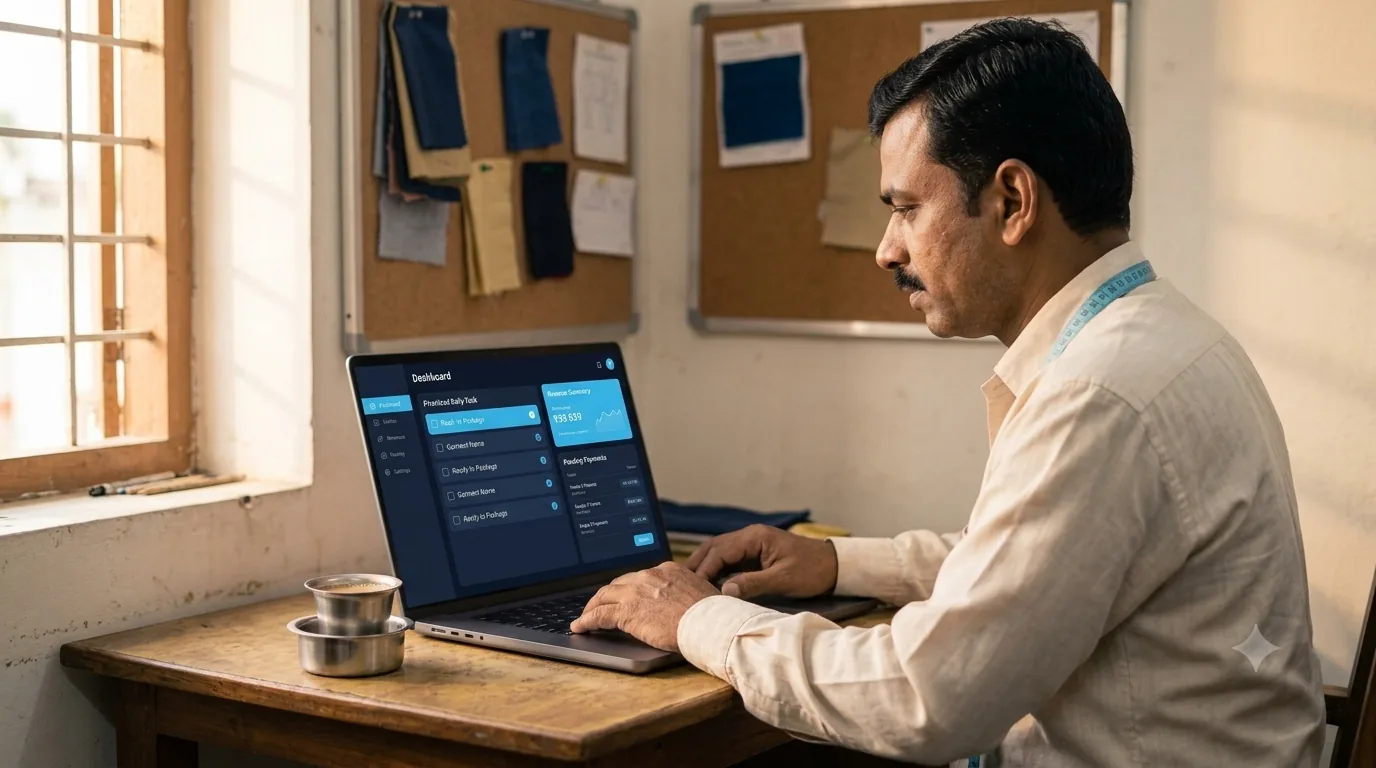
That's the shift. From reactive to in control. For the fuller story of how that studio moved off notebooks entirely, see the Boutica case study.
Signs Your Shop Needs This
You likely don't need to make this decision in the abstract — the signals are usually already there:
- Customers call more than once or twice a day just to ask about order status
- A garment has gone temporarily "missing" in the sense that nobody could say what stage it was at
- Measurement records depend on a notebook that could be lost, damaged, or illegible
- Pending payments are tracked informally, if at all, and some quietly go uncollected
- Work gets assigned verbally, and things occasionally sit because nobody was clearly responsible
If two or more of these are familiar, the cost of running on notebooks and memory isn't hypothetical — it's already showing up in staff time and customer trust, just spread thin enough that it doesn't look like a single problem.
Ready to See How This Works for Your Shop?
Boutica is built specifically for tailoring and garment boutiques with staff — managers, tailors, packaging, and delivery. It handles measurement drawing, item-level tracking, pipeline visibility, WhatsApp notifications, staff assignment, and billing in one place.
Not a generic business tool adapted for boutiques. Built for this from the ground up.
Ibistra Tech builds Boutica, a boutique and tailoring management system built around how tailoring shops actually operate. Talk to us about your shop.